Who Flew First?
The Wright Brothers versus Santos-Dumont

I learned in school, like everyone in the United States, that the Wright brothers were the first in flight. I never imagined this was a controversial claim until the subject came up here in Brazil. My wife was equally adamant that a Brazilian, Alberto Santos-Dumont, was first. I have not yet learned to avoid arguing with my wife, so I set out to investigate the merits of each side of the debate.

The dispute appeared at first to be a matter of simple national pride. Patriotic Brazilian educators wanted children to believe their countryman was first to fly; ditto for those in the United States. But there is more at play.
Air pioneers reveal distinct cultural attitudes toward evidence; they also raise a fundamental question about what exactly constitutes flight. While advocates for Santos-Dumont claim more robust documentation of his activities, the Wright brothers made the more important breakthrough, which enabled the type of flight we take for granted today. In terms of what it means to fly, I argue the ability to steer while airborne is more significant than the ability to launch oneself off the ground.
The Evidence
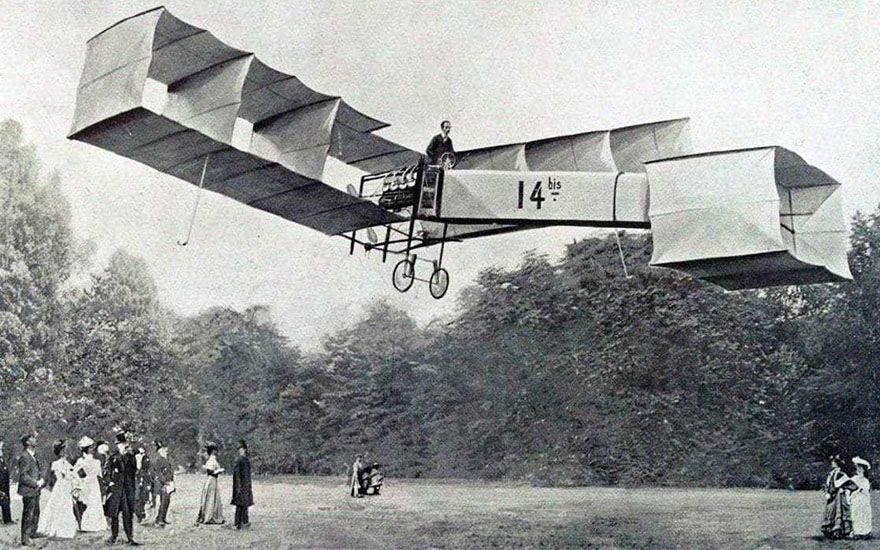
Santos-Dumont accomplished the first documented flight of a heavier-than-air machine in Paris. The Brazilian, heir to an immense coffee fortune, had moved to France in order to experiment with flight. On 12 November 1906, in front of a crowd that included officials from the International Aeronautic Federation, Santos-Dumont flew a 14-bis plane for 22 seconds, covering 220 meters before landing safely.
Two years later, Orville and Wilbur Wright achieved fame with their own public demonstrations. They further claimed they had flown as early as 1903. The brothers had kept their test flights secret for years while patent applications and production contracts traversed the legal system. The Wrights obtained a French patent as early as 1904 and a U.S. patent in 1906. But they refused to allow photography of their machines until they secured a production contract. Such hesitancy led French journalists to cast doubts on the Wrights’ accomplishments; one headline from 1906 asked if the brothers were “flyers or liars?” The Wrights only gained widespread recognition by the summer of 1908, when Wilbur made public demonstrations in France and Orville began aggressive legal action against another American innovator, Glenn Curtiss.
Cultures of Innovation
The different types of evidence unveil distinct cultures of science. Santos-Dumont followed an aristocratic tradition of research, in which transparency and cooperation predominated. Not only did he perform his flights under the full gaze of any interested onlookers, he published technical details of his series of aircraft, the Demoiselle. He wanted others to replicate his designs and improve upon them, in the spirit of collaboration.
The Wright brothers, on the other hand, took a proprietary stance. They were middle-class bicycle mechanics, not playboy heirs, and they intended to profit from their industry. Some critics, who favor Santos-Dumont or another flight pioneer, believe the Wrights are remembered due to their efforts at litigation rather than aviation.
What Does it Mean to Fly?
To me, the more interesting debates are those related to the technical details of flight. Supporters of Santos Dumont emphasize his airplanes’ capacity to take off on their own power. The early Wright Flyers needed assistance to get them up into the air. The Wrights’ first flight, in 1903, may only have worked because of favorable headwinds that December day over the sandy grounds at Kitty Hawk. By late the next year, the Wrights had invented an elaborate tower with a falling weight that generated force to launch the plane from a rail, instead of by rolling on wheels.
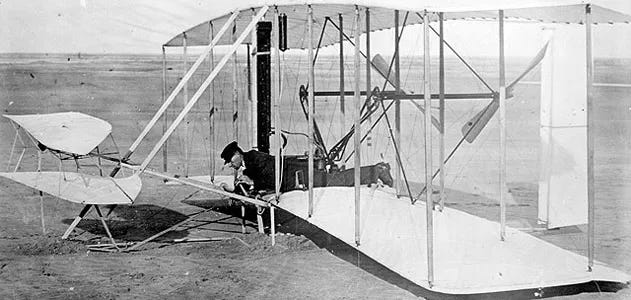
But crucially, the Wright brothers also developed the ability to steer their airplanes. Santos-Dumont’s early craft had no device for lateral control; he could only elevate and descend. It was the Wright Brothers who solved the lateral engineering problem with wing-warping linked to a rudder controlled by a stick. Only then could an airplane make a coordinated turn; only then could a pilot navigate their own flight path. The Wrights completed circular flights that lasted upwards of thirty minutes by 1905, the year before Santos-Dumont’s flight of twenty-two seconds was documented by French officials.
Partisans continue to debate which pioneer made the more important contribution. But it seems clear that if you take off without being able to control your direction, you are not really flying. What Santos-Dumont did can be more accurately described as hopping or skipping. Only when the Brazilian aviator adopted the Wrights’ system of lateral control in 1909 could he claim to be navigating through the air, or flying.
The debate reminds me of French historian Marc Bloch, who warned about the “idol of origins.” People often try to pinpoint the beginning of something — a people, a language, an idea — at the expense of understanding how change takes place. After all, the first aircraft looked more like kites than today’s jets. More important than the individuals who took the first flights were the improvements made by countless unknown people who toiled across decades.
Being first matters for patent law, in terms of who receives the material reward. But aviation was a collective undertaking, driven forward more by the likes of transparent Santos-Dumont than the secretive Wright brothers (or, as Gabriela calls them, the Wrong brothers). It is less important in history to be recognized as first, and more important to collaborate for progress.
For Further Reading:
Daniel Schlenoff, “Scientific American Debunks Claim…‘First in Flight,’” available from: https://www.scientificamerican.com/article/scientific-american-debunks-claim-gustave-whitehead-was-first-in-flight/
Tom Crouch and Peter Jakab, The Wright Brothers and the Invention of the Aerial Age (National Geographic, 2003)
Paul Hoffman, Wings of Madness: Alberto Santos-Dumont and the Invention of Flight (Hyperion, 2003)